

ON HOPE
Positive delusion and philosophical psychosis

Recently, in conversation with a friend, I reached a point that I have come to call “philosophical psychosis.” Which is to say, that I started using Kierkegaardian theory to justify my questionable decisions.
As I spoke, I became aware of a subtle internal shift, a rearrangement of posture and tone, as though I were sliding from one register of self into another. I was no longer simply explaining myself; I was authorizing. I could hear how the words sounded as they were leaving my mouth, could feel my essence shifting in front of her as I morphed from a rational, practical girl into one overcome by her own symptom of delusion.
Or, more likely, it is the case that none of my friends have ever thought of me as a rational, practical girl.
Our conversation was more of a contemplation, circling a particular choice I was making, a decision that I had already made in my mind. I was doing the thing people often do when they’ve already made up their mind but feel compelled to ask others for counsel, just so they can get some reassurance. But when they don’t agree, when they don’t tell you what you want to hear, it becomes dreadfully obvious that you were never asking for advice, only permission.
Confusion and Quiet Delusion
This is not unusual for me. There is a particular way I tend to make decisions, which is to say that they rarely feel like decisions at all. They arrive instead as a kind of momentum, a pull that precedes language and feels more like following an internal direction.
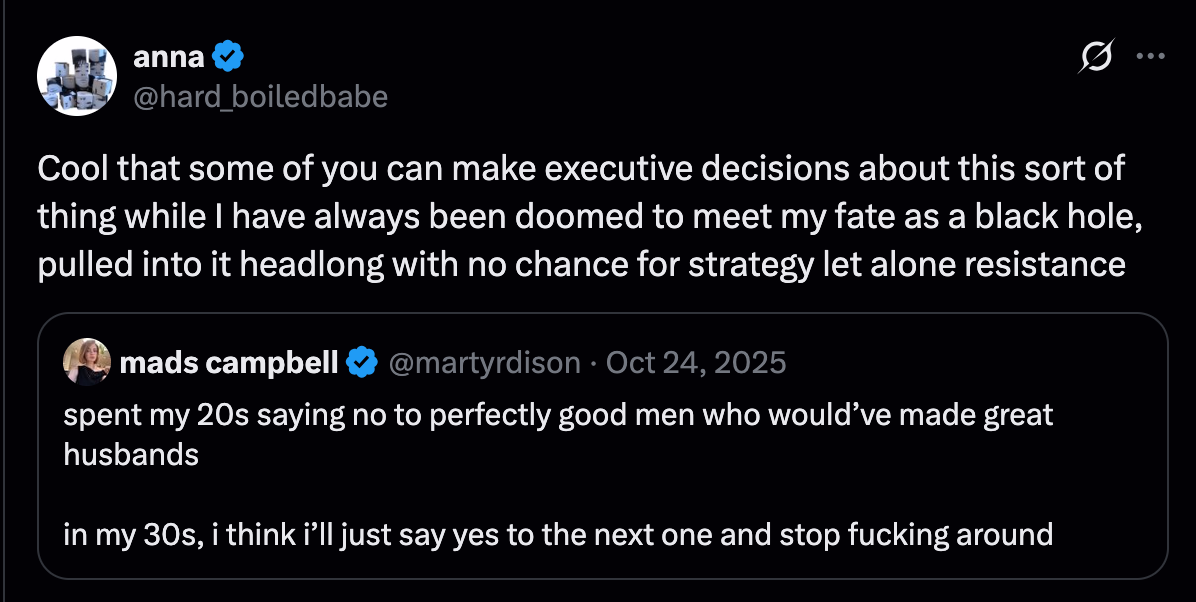
The direction announces itself first: a gravitational pull, immediate and bodily. Only afterward does my mind rush in to make sense of it, to gather reasons and explanations and arrange them into something that resembles deliberation rather than impulse. I can feel this sequence unfold as it happens: desire first, then architecture. My structure of reasoning is erected around a foundation that’s never fully examined.
And in these conversations of contemplation, I am often warned to do otherwise. To go the opposite direction, to resist the gravitational pull, to choose differently.
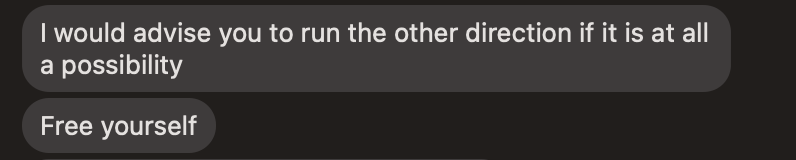
And my friends are often right about these things. They are specific, grounded, unromantic in the best sense. With the clarity that comes from distance, they describe the risks involved, the likely outcome, the precise ways I am liable to get hurt. I half-listen, and I agree. I even feel a kind of relief in their lucidity. And then I do the thing anyway, because the pull is stronger than prudence, because something in me insists on moving toward the thing that everyone else can already see will burn.
Not because I think they’re wrong, but because the wanting is stronger than wisdom. Because something in me needs to see it through, needs to touch the hot stove, to walk into the situation that everyone can see will not go my way.
What I’ve never been able to determine is whether this insistence is fidelity or compulsion. Whether I’m obeying something essential in myself, some inward necessity that refuses to be reasoned with, or merely repeating a familiar pattern that has come to feel indistinguishable from identity.
Kierkegaard insists that there’s a difference between being called and being driven, but I find these incredibly difficult to tell apart. Obsession, addiction, vocation, and faith all arrive with the same authority, the same sense of inevitability, the same internal voice that says: you must do this. But how do you distinguish between a calling and a craving? How do I tell if the gravitational pull towards a particular choice is following myself, or betraying it? How do I tell the difference between a choice I have to make and a choice I want to make?
Sometimes I think the difference is that a calling feels heavy, like responsibility, something you have to do even though (especially though) it scares you. But this is slippery, because addiction feels like that too, obsession feels like that. Any number of destructive patterns can masquerade as destiny if you hold them in the right light and squint.
And sometimes (fine, often), my friends are correct. Sometimes I walk straight into the disaster they all predicted, and have to make do with that wreckage, have to admit that yes, everyone saw this coming except me. But sometimes (rarely, but sometimes) the thing that looked like a mistake turned out to be exactly what I needed, or at least that’s what I tell myself after it’s all transpired. The detour that became the path, the risk that paid off.
Or maybe—and this is the hope I keep returning to—there’s something in that wanting, in that gravitational pull, that knows better than my rational mind. Maybe the part of me that chooses badly is also the part that chooses authentically.
Philosophical Psychosis (Writing In Blood on My Walls Cause The Ink in My Pen Don’t Look Good in My Pad)
Last year I read Works of Love by Kierkegaard. Or rather, I read parts of it, the parts that stuck, the passages I underlined and photographed and sent to friends with the breathless conviction that I had discovered something profound.
What Kierkegaard is doing there is not exactly comforting. He doesn’t promise happiness, or success, or even coherence. He insists, almost to the point of cruelty, that one must choose “the good” regardless of outcome, regardless of whether it feels rewarding, regardless of whether it appears to work. Love, for him, is not preference or inclination, but duty. It’s the idea that “the good” is what you owe rather than what confirms you. You’re commanded to will the good even when it offers no evidence that it will love you back. There’s something bracing and kind of unhinged about this: the demand that you act without guarantees, that you commit yourself without any proof that the future will justify you.
What I took from this was that we must hold unwavering faith that things will turn out for the better, otherwise they never will. That hope is active creation rather than passive optimism. That the future is unknown, and in that unknowability, we have a choice: to foreclose possibility through despair, or to hold it open through faith.
This felt like permission, like a philosophical justification for doing exactly what I felt compelled to do.
Because here’s what I’d been thinking about, before I picked up Kierkegaard: that any prediction about the future is, by definition, delusional. The very nature of the future is based upon the fact that I don’t know what’s going to happen. We can base our predictions on past experience, on pattern recognition, on what other people tell us, but none of that amounts to anything that resembles certainty. (Hume knew this, by the way: just because the sun rose yesterday doesn’t mean it will rise tomorrow. Induction has no necessity. Past experience gives us habit, not truth.)
So if the future is unknowable, I reasoned, then all positions toward it are equally ungrounded. You can believe it will be good (which is what I call positive delusion) or believe it will be bad (negative delusion), but either way you’re making a claim about something that hasn’t happened yet. (I am fully aware that when you Google “positive/negative delusion” the only results pertain to schizophrenia.)
The difference, I thought, is that negative delusion is safe. If you predict failure, you can’t be disappointed. If you walk away before things have a chance to play out, you can always tell yourself it never would have worked anyway. You foreclose the possibility, but you also protect yourself from being wrong.
Positive delusion, on the other hand, is vulnerable. If you hope and you’re wrong, if you follow the path and find a dead end, then you can’t conceal yourself from your mistake. You’re exposed as naive, as foolish, as someone who couldn’t read the signs everyone else saw.
But (and this felt like the key insight) you can only be wrong if you hope. If you give up, if you call it early, then you never have to find out. Negative delusion is unfalsifiable; it allows you to preserve your self-image as someone who was smart enough to cut their losses, who knew better than to waste their time.
And so I constructed this theory: that positive delusion is the only way anything good ever happens. That if you don’t hold faith that the good will happen, if you protect yourself by predicting failure, you guarantee the failure. You create a self-fulfilling prophecy and then get to feel smart about it.
And Kierkegaard, I thought, agreed with me. He was saying that faith means acting in the face of uncertainty. That hope is not about knowing things will work out, but about remaining open to the possibility that they might, by letting it happen.
I felt very smart about this, very philosophically sophisticated. I had an entire framework now for doing what I felt compelled to do. And it wasn’t just desire, it was existential responsibility. By making the choices that I felt drawn to make, regardless of their prudence, I was doing something very Kierkegaardian. I was engaged in the very righteous, very philosophical pursuit of self-enactment. In fact, I was doing something godly. And to abandon this path, the path one must follow in order to become oneself, is not just irresponsibility, but a sin—you’re refusing to be the self that God has called you to be.
Except now, I’m not sure I read Kierkegaard right. Or rather, I’m not sure I read him honestly.
Philosophy is difficult. Not just intellectually hard, but interpretively hard. You can’t just pull a quote and take it as universal truth. The context matters, there’s always a correct way to interpret it. And it can be difficult to find the correct interpretation purely on your own. You can’t just pick the passages that confirm what you already wanted to believe and call it philosophy, but we do it anyway. I still do it anyway.
This is what leads to what I’m calling “philosophical psychosis”: the moment when you’ve read enough to be dangerous, when you have sufficient vocabulary to make your delusions sound sophisticated, when you can cite authorities to justify choices you were going to make regardless. Where you gather enough quotes, references, and establish a loose character of authority that you can appeal to. And once you have done this, you can defend yourself. If anyone ever questions you, you can point over to that unstable structure of theory and say “But according to that framework, I’m correct.” It’s not that the philosophy is wrong, per se. It’s that you’re using it wrong, deploying it as an alibi instead of truth.
Kierkegaard himself warns about this. He says explicitly that religious language (existential language) can become the most sophisticated form of avoidance, precisely because it carries such weight, such seriousness, such unfalsifiable authority. That faith, when misused, looks like depth. It looks like someone grappling with the really important questions, because they are, but falsifying their way into the answer they want. In Concluding Unscientific Postscript, he says: “There is no danger that a person who is sincerely concerned about his own inwardness will be confused with the person who is concerned about explaining inwardness.”
The Perversion of Hope (Serving Up God in a Burnt Coffee Pot for The Triad)
When you (let us speak of you, though I mean I) are making what might be called “a bad choice”—when everyone tells you it’s a bad idea, not in a vague way but in a very specific, plain, “we can see exactly how this is going to hurt you” way—the kind of situation where even you can see the problems, where you aren’t blind to the obstacles or naive about the likelihood of things ending badly. But you still want to choose it, compelled by that non-verbal, gravitational pull. And you can’t explain why, can’t locate the source of the wanting, can’t tell if it’s coming from some essential part of yourself or from something much less noble: obsession, ego, the particular thrill of pursuing what’s bad for you.
So I made a case, I built an argument. The argument was: I have to follow this. I have to see it through. Because if I don’t, I’ll never know. And not knowing—walking away out of self-preservation, out of prudence, out of listening to everyone who says this is a mistake— would be its own kind of betrayal. It would be an abandon of self, which is a sin.
I invoked Kierkegaard. I talked about the self being disclosed only in commitment, about how you can’t become who you are by playing it safe, about how real despair is the refusal to risk. I said: everyone telling me not to do this is operating from fear. They’re foreclosing possibility, engaging in negative delusion. They’re predicting failure so they don’t have to be vulnerable to hope, while I’m choosing positive delusion. I’m choosing to will the good. Because I am the kind of person who holds her heart open to the world, who exercises faith in the face of uncertainty, even if the odds are against me. And that choice, that act of hope as one stands before the unknown, is what it means to live authentically.
I could hear myself saying this. I could watch my friend’s face as I said it. And some part of me knew, even then, that it was possible that I was performing a distortion. That I had taken real philosophical concepts and weaponized them, or let them pull me into a state of philosophical psychosis, where no one could tell me I was wrong or convince me otherwise. But stopping would have meant admitting that I didn’t have a good reason, that I just wanted what I wanted and was clothing it in existential dress, so that it might pass for virtue.
The Despair of One’s Self (24/7 Sylvia Plath)
And here is what I didn’t understand then, what I’m only beginning to understand now: that following yourself does not save you from despair.
Despair, according to Kierkegaard, is not a prediction about outcomes but a refusal of possibility itself. It forecloses the future in advance, says “this cannot work,” not because the evidence demands it but because remaining open would require you to risk something (whether that something is disappointment, vulnerability, the humiliation of having hoped for nothing).
But what he doesn’t say (or what I couldn’t hear) is that hope itself can also be a form of despair. That sometimes what you’re hoping for is not the future opening, but your own vindication. That sometimes you’re using hope as a weapon against everyone who doubted you, against every voice that told you to protect yourself.
And hope, when it’s honest, is not about what you want. It’s about acting in relation to something beyond the self, something Kierkegaard calls God but which might also be understood as truth, reality, or the demand that you face what’s actually there rather than what you wish were there. In my case, it is hard to tell if I was hoping or insisting, taking my wanting and baptizing it in philosophical language and calling it faith.
The question is not whether the future vindicated my hope, but whether I was hoping honestly or using it as cover for desire, ego, for the refusal to accept what was already visible to everyone but me.
Hope Is A Dangerous Thing For A Woman Like Me to Have—But I Have It
For Kierkegaard, hope is neither optimism nor expectation. It isn’t the belief that things will turn out well, or even that they will turn out intelligibly. It’s simply the refusal to foreclose possibility in advance. Despair says this cannot be, but false hope says something just as despairing: this must be. Both are ways of deciding the future before it arrives, of protecting the self from having to encounter what’s actually given. Real hope, for Kierkegaard, is more restrained than that. It doesn’t predict or insist. It stays in relation to possibility without mastering it, without demanding that the future justify one’s desire or reward one’s faith.
Hope is not confidence in an outcome, but fidelity to openness itself. And hope, when it’s honest, is not nearly as flattering as I wanted it to be.
I had mistaken it for permission, a forward-leaning force. I thought hope meant continuation, insistence, the refusal to be talked out of what I already felt compelled to do. I thought it was proof of character; that I was brave enough, open enough, alive enough to wager myself on what might be. That choosing hope meant choosing movement, risk, choosing to remain porous to the future even when everyone else had already sealed it shut. But this was not hope so much as it was momentum, so much as it was trying to force the outcome I wanted.
The hope Kierkegaard explains is colder, more austere. It doesn’t promise that things will work out, only that reality will be allowed to reveal itself. It’s not faith in a favourable outcome but faith in correction; a willingness to be contradicted by what actually happens, rather than protected by a theory of what should have happened. Hope, in this sense, does not say this will be good—it says I will not lie in advance.
This is where I went wrong. I treated hope as a solvent for doubt, as something that dissolved caution, objections, even my own better judgement. I believed that if I followed myself, if I let myself be pulled in that gravitational direction, that I would be rewarded. I believed that to hesitate would be to betray myself, that to resist the self would lead to despair. But despair, I’m realizing, is not always refusal. Sometimes it comes through insistence. Sometimes despair is the quiet delusion of saying this must be the right choice simply because I want it.
And if despair forecloses the future by predicting failure, then false hope forecloses it by demanding success. Both are ways of managing uncertainty rather than accepting it. They both try to protect you from the humiliation of being wrong, they both keep reality at a safe aesthetic distance.
I still believe that despair is a refusal of possibility, that a life lived entirely on the basis of self-protection becomes small and brittle. But I no longer believe that hope announces itself through your desire, or that faith can be measured by how much you’re willing to suffer in pursuit of what you want.
Hope, if it is to mean anything at all, has to survive the moment after you’ve been wrong—after the path collapses, after the theory fails, after the future refuses to cooperate with your narrative. It has to remain when the wanting has burned itself out and there’s nothing left to authorize or defend. And that kind of hope no longer feels like permission, it feels like responsibility.
This is incredible. Amazing work, Anna
timely read. I love your mind