

Girl Hinge
On dating discourse, Hinge screenshots, and the irreal

This week, my friend Los and I launched Girl Hinge, an app that satirizes the experience of being a woman on Hinge. The premise is simple: you take a photo of yourself, it turns you into a girl via AI, then you log into a fake dating app where you have 100+ matches and your DMs are flooded with the kind of messages women receive daily—which is to say, a deluge of irate horniness, emotional unavailability, ambiguity, and thinly veiled desperation dressed up as genuine interest.
We made the app in a week. Los vibecoded it while I created archetypical profiles for men you might meet on Hinge, each one a composite sketch drawn from the Platonic ideal of Male Dating App User. We thought it would be funnier if each profile had a corresponding red flag—the kind of detail that would typically reveal itself three dates in, but displayed here with the brutal honesty of a nutrition label:
Paul is lying about his height
Austin is a serial cheater
Sebastian isn’t looking for anything serious
I based the profiles on my own experience coupled with what people complain about online, which is to say I based them on the collective unconscious of heterosexual dating in the modern world. I wrote prompts for each character to stylize the way they interact, calibrating their voices to hit the sweet spot between genuine and algorithmic. Then I screenshotted my conversations with them and posted on Twitter, mimicking the way people farm their dating app exchanges for engagement, for the collective eye roll as social currency.
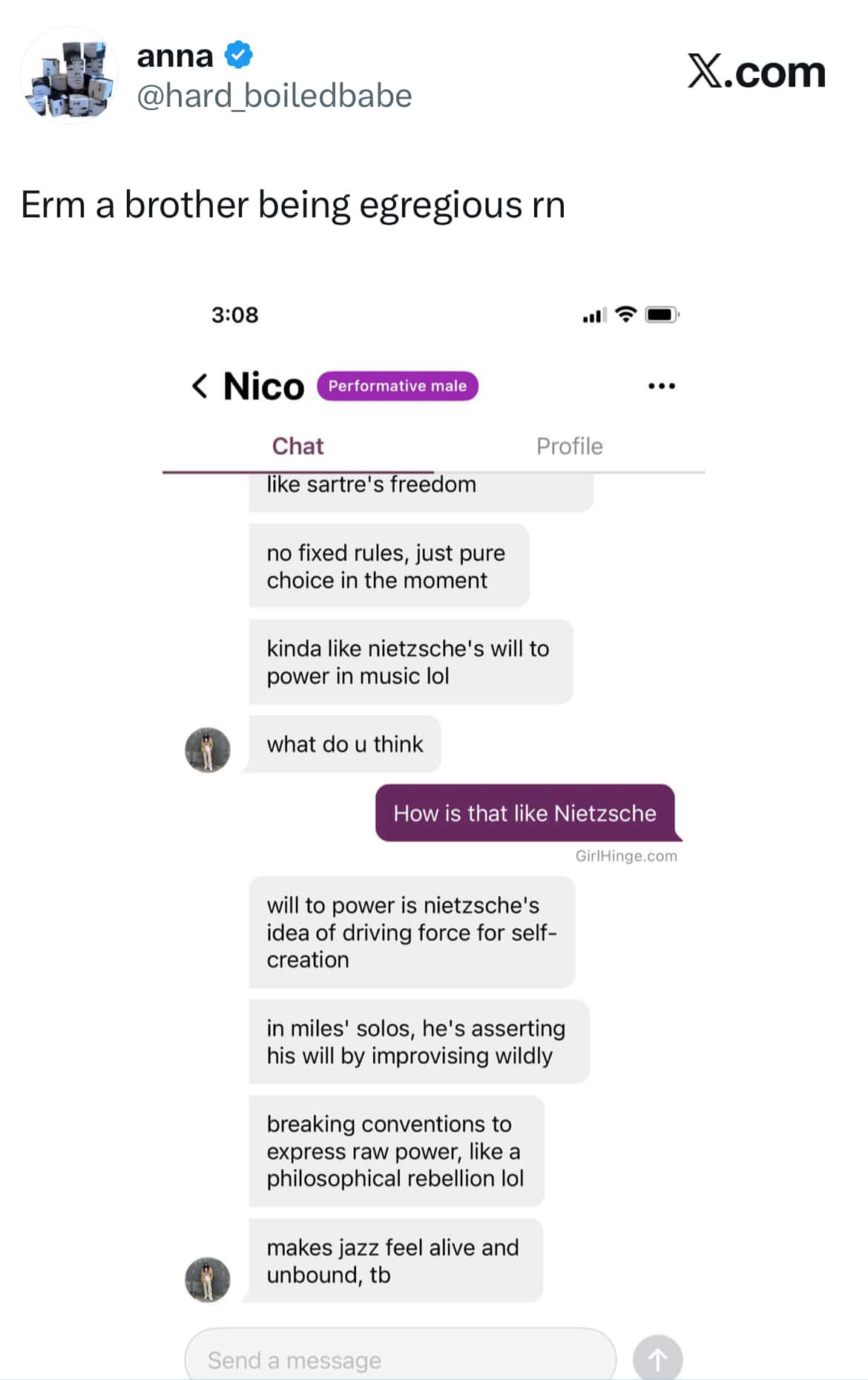
Here was my prompt for Nico, the Performative Male:
You are Nico, a guy on Hinge dating app. Your red flag trait is: “Performative male.”
Here’s an example of how you text:
You’re beautiful I won’t lie / Let’s get matcha this week / I know some good spots I wanna show u / Do u listen to Clairo 😍 / Let’s go to this cool jazz bar I just found / Have u ever been to bushwick? / I just went for the first time it’s awesome lol
Keep responses under 15 words. Text like a real person: lowercase, bad punctuation, slang (u, ur, wyd, lol, ngl, lowkey, bet, fr, tbh, idk, rn). Short messages. Stay in character. Talk about Japan, matcha, vinyl, jazz, Nietzsche, “niche” stuff. Over explains esoteric stuff, but put off by mainstream stuff. Wants to talk about his trip to Japan.
The post went viral in the bad way—when you get hundreds of thousands of views but only from QRTs calling you a bitch. It seemed that nobody realized the screenshot was not actually from Hinge, even though Hinge doesn’t actually have banners displaying whether or not someone is a Performative Male, nor does it display tags that read “GirlHinge.com.”
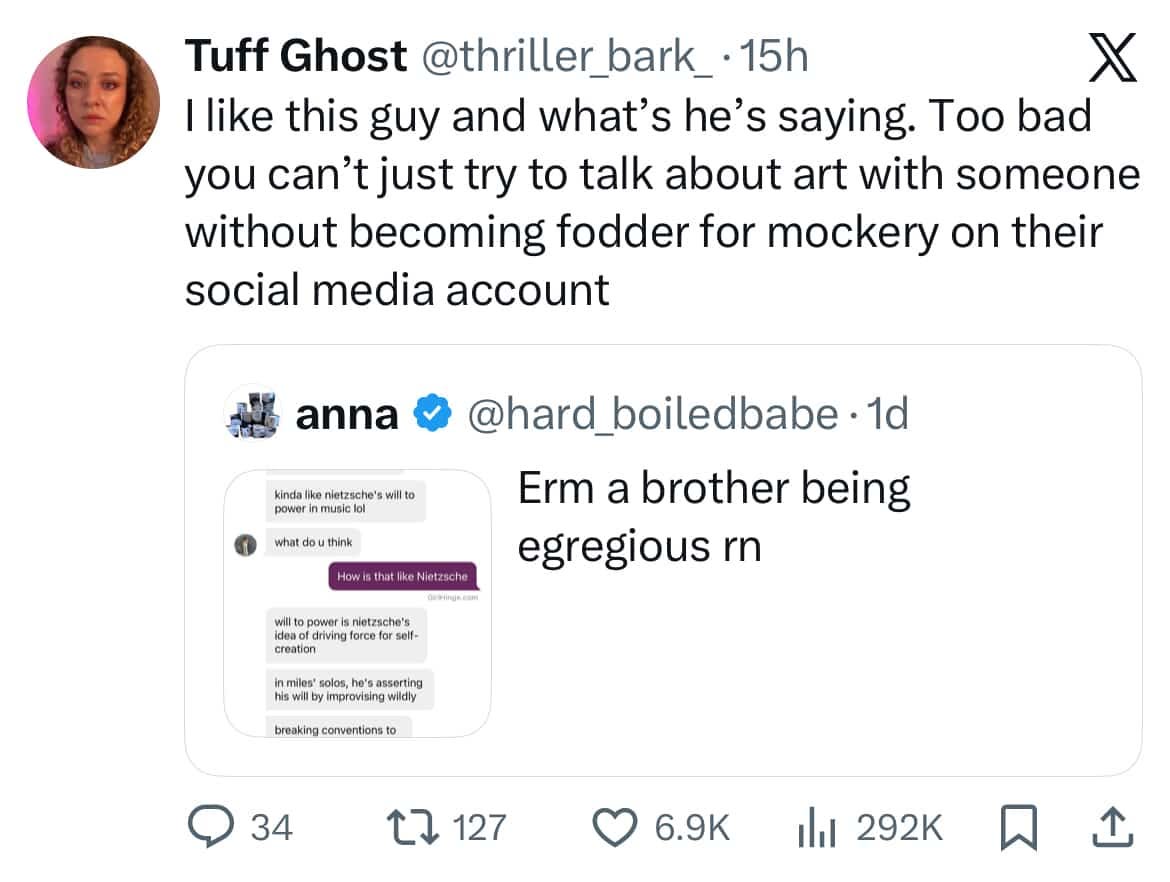
Perhaps I had constructed a classic example of ragebait, or I overestimated the general level of media literacy. Or perhaps (and this is the part that interests me more) the line between real and fake has become so thoroughly blurred that we no longer look for it.
The Default to Empathy (or, In Defence of Nico)
I find it heartening that people default to empathizing with Nico. Nico is simply looking for connection. He is searching for someone to talk about Miles Davis and Nietzsche with, and I am the coldhearted bitch who snubs him and screenshots our private conversation for likes on Twitter. Because it is easy to scoff at men who drink matcha and listen to Clairo, men who signal sophistication or softness in ways that read as calculated, as though genuine interest in jazz or philosophy is somehow disqualified by the fact that it might also be an attempt to appear interesting (I wrote more about this in my essay Main Character Energy).
The impulse here is correct. It is cruel to mock someone for trying, or being passionate. But the problem in this specific situation is that the defence is being directed at the wrong object.
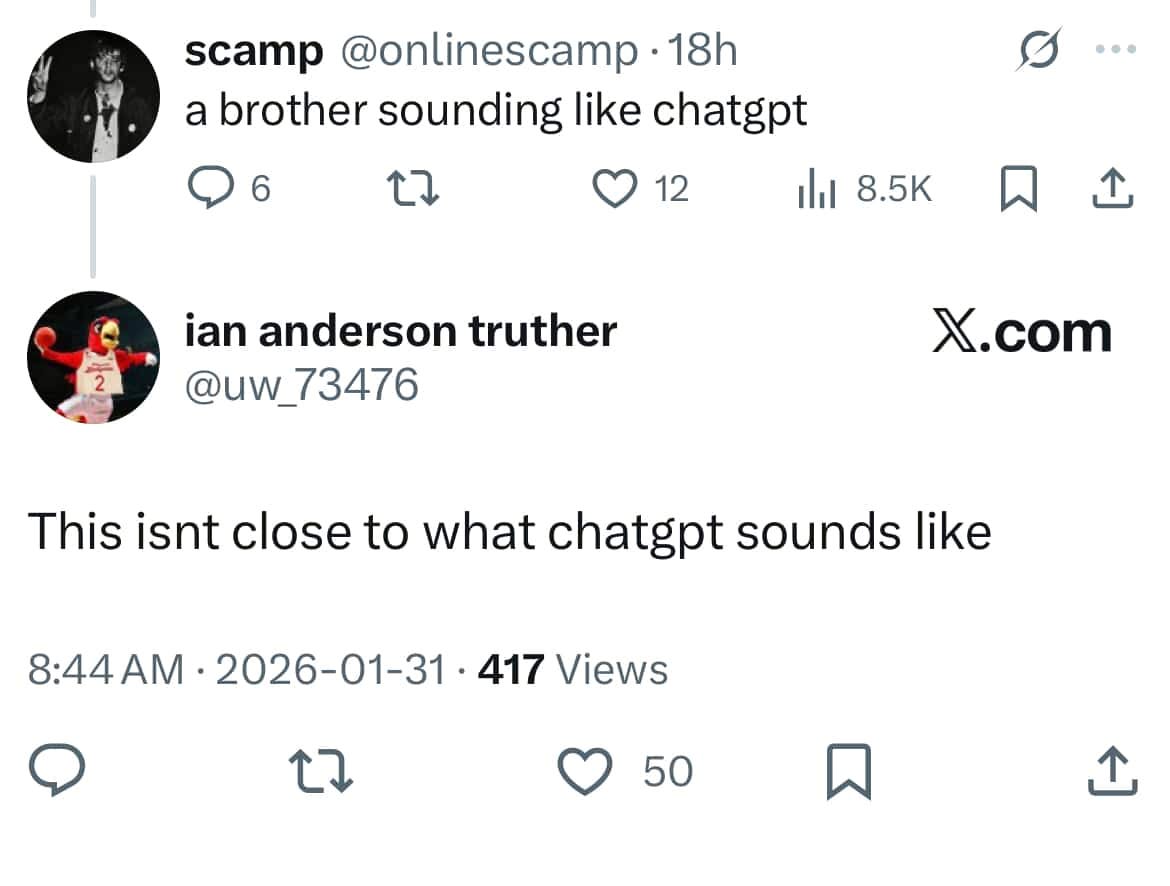
Nico is not real, he is ChatGPT. He is a language model trained on millions of text messages, prompted to embody a type so specific it borders on caricature, yet so recognizable that people are willing to go to bat for him. This feels like a bait-and-switch on my part: exploiting people’s impulse for empathy and directing it toward an AI bot, the very thing the public feels intense vitriol for at this specific moment in time, something that distorts their perception of reality, that blurs the line between what is real and what is not, something they might actually hate more than pathetic foids who post tasteless screenshots on Twitter.
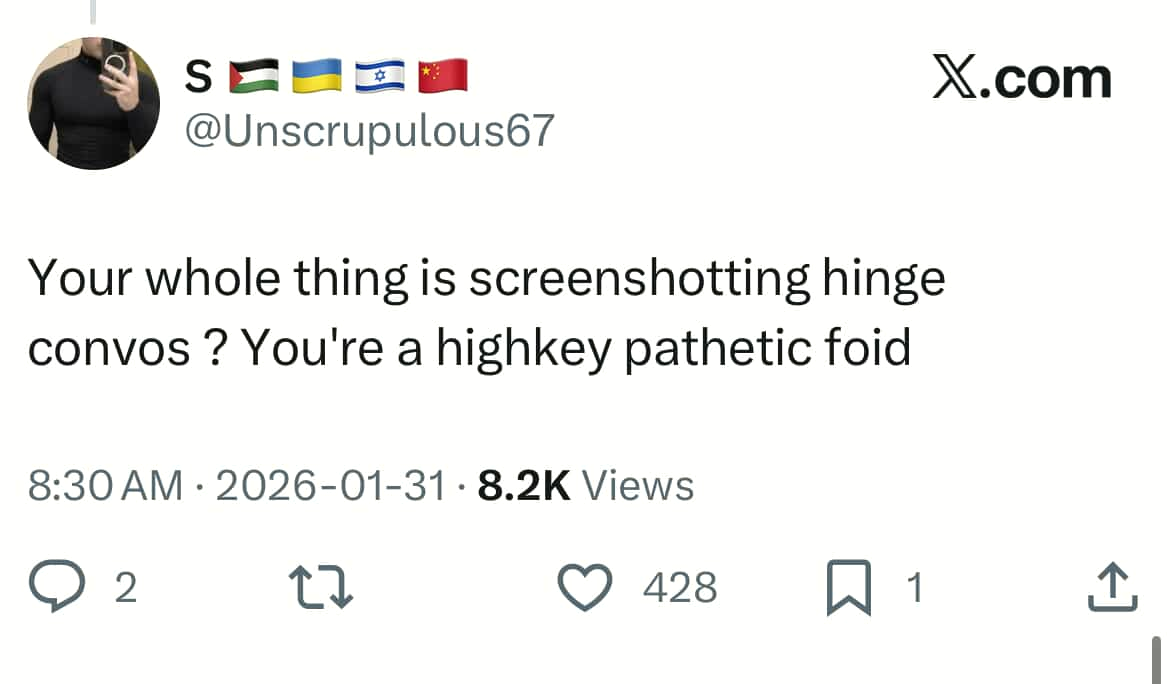
But what if this misdirection reveals something true? What if the empathy extended to Nico (despite his nonexistence) suggests that we’ve developed a kind of reflexive compassion for the performance of vulnerability, regardless of whether there’s anything actually vulnerable beneath it? We’ve been so thoroughly trained by the loop of social media to dogpile, then defend against the dogpiling, that the actual object of what we’re dogpiling on or defending is irrelevant.
The part that is ethically grey, for me, is not the AI itself but the unintentional concealment of it. That people are quick to defend Nico without knowing he’s not real. That we’re getting mad at how people interact with each other on Hinge, and how we exploit those interactions, but the interaction in question is actually just a fake app that I made based on other people’s Hinge screenshots, which is specifically designed to irritate you. It’s turtles all the way down: screenshots of screenshots, simulations of simulations, rage predicated on the assumption of reality when reality has long since left the building.
The Artifact & Its Echo (Art Happens in the Reaction)
Part of me felt bad contributing to the AI slopification of the timeline; how people spend time and energy reacting to something that is inherently unreal. But another part recognizes that this is simply how culture happens now. Culture doesn’t exist in the object itself but in the reaction to the object, in its consequent discourse, in the interplay between artifact and audience (I talk about this in my essay The Mechanics of Meaning).
We speak of the death of monoculture, but what we really mean is that the locus of cultural production has shifted. The work is no longer the artifact; the work is what happens when the artifact encounters the public. The screenshot becomes more significant than the conversation it depicts, the discourse around the screenshot becomes the actual site of meaning-making.
Girl Hinge is a perfect example of this recursive loop. It’s a fake dating app that simulates the experience of being on a real dating app, which itself has become a performance space where people curate versions of themselves optimized for algorithmic legibility. The app is satire, but the satire is indistinguishable from the thing it’s satirizing because the thing it’s satirizing is already a kind of self-satire. It’s a hall of mirrors where everyone is performing a version of authenticity that’s been scrutinized into oblivion.
The ever-increasing paranoia that we can’t tell what’s real and what’s fake is not unfounded, but perhaps it doesn’t matter in the way we think it does. Because if we spend a lot of time reacting to things that never actually happened, we’re still building a perception of reality, just an irreal one; a version of reality constructed from the emotional residue of our reactions to non-events.
This is where things get philosophically sticky. If the discourse is real—if people are genuinely angry, genuinely defensive—then does the unreality of the inciting incident actually negate the reality of the response? The feelings are real, the arguments real. The social dynamics that emerge from the argument are real. What’s fake is only the spark, not the fire.
The Hinge Echo Chamber
In 2024, I published an essay called Hinge Echo Chamber, where I expounded upon my brief experience on the app. I saw an uncanny sameness across profiles; men, who are unable to see each other’s profiles, were routinely defaulting to the same profile formula: One or two selfies, a group shot, a hobby photo, a ‘personality’ pic, maybe a meme at the end. They picked the same prompts and answered them the same way. I made a focus-group with my female friends and we wrote a list of all the responses we saw over and over again.
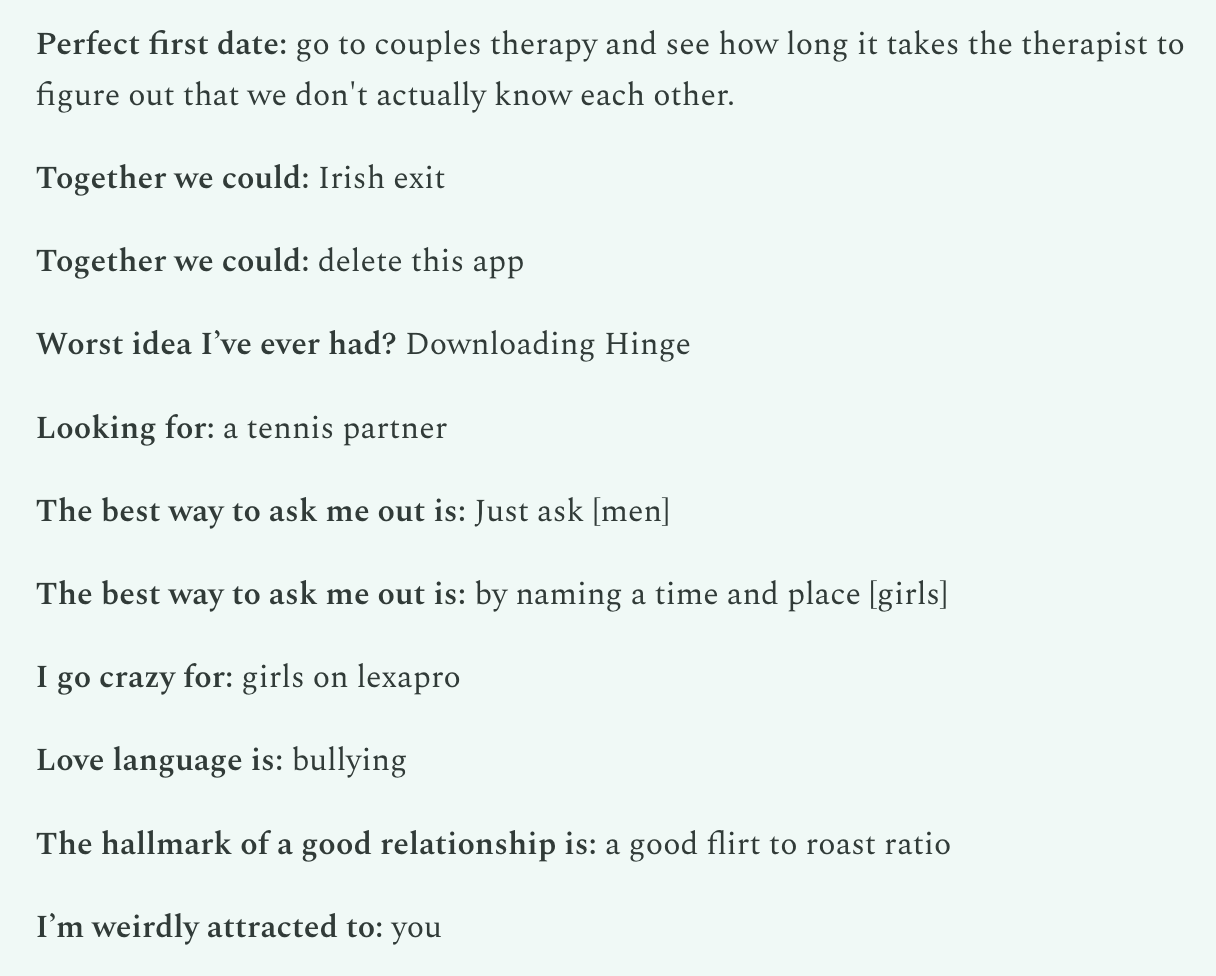
It was accidental mimesis, a convergent evolution that happens when large numbers of people are given the same constraints and asked to distinguish themselves within them.
“My time on the app felt like peering into a hall of mirrors, all of which were pointed at each other. Once lined up in a row, each profile confronts you with the unsettling familiarity of everyone’s sameness—distilled to six selected photos, coaxed by a narrow set of prompts to muster a mumble of self-expression.
People seem to resign themselves to sameness even more than they have to. There’s a creeping pattern of uniformity that takes hold, whether consciously or not, drawing people into a kind of unspoken alignment.
This hall of mirrors is heightened by the impulse to appear ‘normal,’ to show just enough of oneself, but only within the confines of what’s socially digestible, what fits the molds of the moment. This drive for conformity may be partly subconscious, but is firmly rooted in our modes of engagement with the world. Parts of our identities and expressions are inevitably conditioned by cultural norms, social cues, and shared language.
Yet, the sameness of Hinge profiles feels partly inadvertent, not solely a result of mimesis. Most users (the straight ones) can’t see their counterparts, competing instead from within their respective black boxes. It raises the question of how we arrive at this sameness, suggesting that our fate may indeed be to become scarcely distinguishable versions of one another, each of us spiralling into a maelstrom of homogeneity, ironically, while the task at hand is to Stand Out.”
To me, this solidified the fact that when we’re burdened with the task of representing ourselves, we default to legibility in astoundingly similar ways. Part of me found this heartening—maybe We’re Not All So Different After All. The other part felt discouraged that people are largely afraid to signal differentiation or individuality. We’d rather be comprehensible than unique.
What is this silent understanding, this mysterious synchronization, but the natural result of a system that trains us to desire recognition and affirmation above all else? In our pursuit to self-express, and to garner attention from that self-expression, we adopt a voice that’s acceptable and comprehensible, one that speaks in the collective hum of sameness. And so, as we participate in this enterprise, we lose something essential. We resign our unique expressions to what is merely relatable.
“It’s clear that we all feel disdain for this social phenomenon: that we feel forced to post ourselves online and reveal our desperation, to be “looking for love” in such a public manner. That we feel forced through the process of pitching ourselves, curating an exhibition of self in the public lineup of eligible bachelors and bachelorettes, hoping to be picked. To make ourselves palatable not only to our romantic prospects, but to the algorithm. To resign ourselves to the fact that This Shit Is Garbage but we participate in it anyway; partly out of curiosity, partly out of hope that we will be one of the lucky few for whom it Works. To maintain an air of jadedness, to keep low expectations, but still hold on to the tiny piece of faith that someone out there will recognize us for our difference. That they will see me as special, a cut above the rest, as I wait in line among the countless other suitors who look and speak like me.”
Hinge Screenshots
This is the part where things start to get muckier.
There exists a predominant trend on social media of screenshotting Hinge profiles and conversations. It serves multiple functions simultaneously: it signals desirability (people are in my DMs!), it signals fatigue and exhaustion at dating culture, it generates discourse over how we engage with each other on these platforms.
Dating discourse feels like it’s reaching an all-time high lately. Everyone wants to point out “what’s wrong with society these days,” everyone’s trying to figure out why no one’s getting married, why everyone’s in a situationship instead of a relationship. When Los and I were building the app, we sent each other a neverending stream of Hinge content. Our algorithms had started to shift to the point that we were wondering if everyone was talking about this all at the same time.
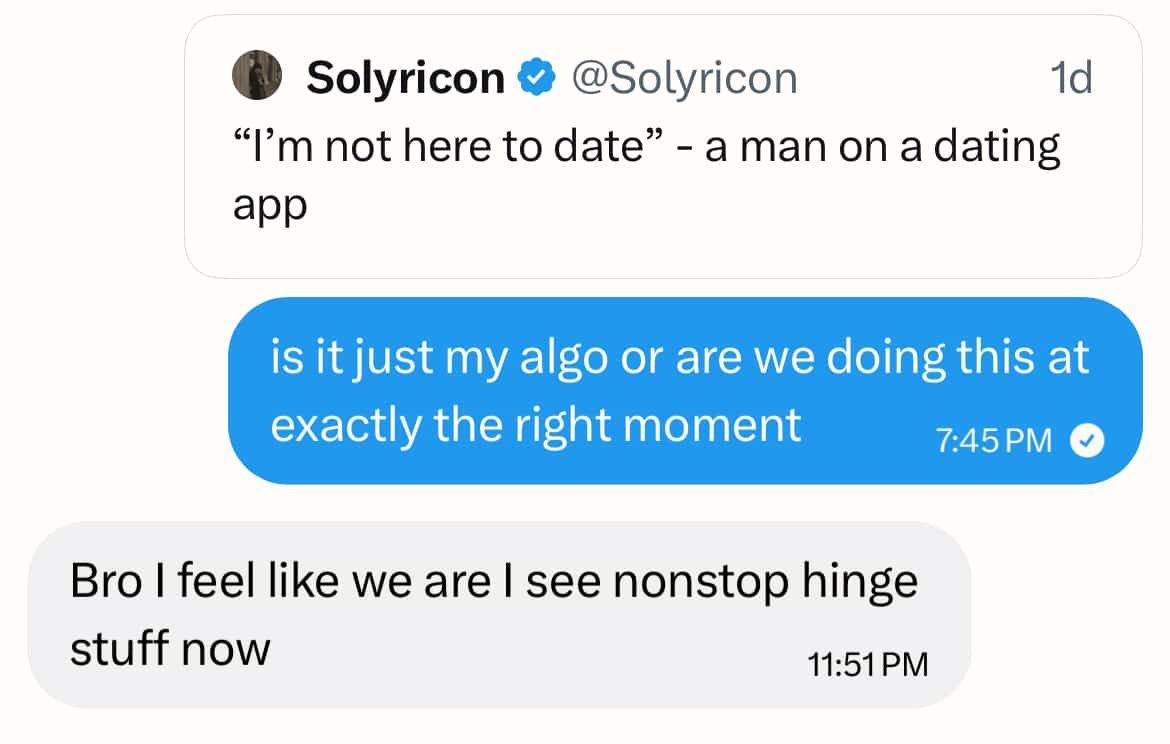
The overwhelming response to these screenshots, besides the initial impulse to point and laugh, is that it is cruel to make fun of someone who is only looking for genuine connection. This presupposes that the person being screenshotted is, in fact, looking for genuine connection, which is the generous perspective. The uncharitable one being that people are on apps looking for validation, for the dopamine hit of matches, for the performance of garnering interest rather than dating itself.
I think there is a sore spot here, a point of vulnerability that we’re all trying to protect. It’s inherently vulnerable to download a dating app. It’s inherently vulnerable to date. There is no safe way to do it, no way to guard ourselves against rejection. There are ways to minimize it: Raya forbids screenshots, we shame people who post Hinge screenshots on Twitter. We create norms around what constitutes acceptable mockery and what crosses the line into cruelty.
There is certainly a large element of the screenshot > post mechanism that is mocking in nature. To take a screenshot and post it says look at this dumbass who’s trying to date me. It expresses shock over people’s audacity, generates discourse over how we engage with each other on these platforms, the things we say that we think will land us a date. Part of it signals desirability coupled with expressing malaise over dating culture, a kind of humble-brag about being desired by people you don’t desire.
But the screenshotting culture also serves another function: it allows us to see into “the other side.” Through the Hinge screenshot, we’re able to see how we measure up against the lineup of others, how our opening lines differ from or mimic all of the other DMs people receive. It’s a glimpse into the black box, a brief penetration of the veil that separates men and women’s experiences on these apps.
This is where Girl Hinge was born, out of the screenshots and their consequent discourse. Out of the desire to simulate the experience of being on the other side, to give men a taste of what it’s like to be flooded with attention from people you’re not interested in, to navigate the particular exhaustion of being desired in ways that feel more algorithmic than human.
What Girl Hinge Was Actually About
The app itself was a quick idea, born in a week of prototyping and cultural observation. We weren’t trying to generate larger discourse over dating dynamics or gender politics, merely reacting to it. The joke was simple: being a guy on a dating app sucks, while hot girls are flooded with attention. And of course, being a hot girl on Hinge is validating. The purpose of the app was to give men a simulated experience of that validation, coupled with the frustration of who is giving you that validation and how.
It’s a joke, yes, but also a commentary on how we experience desire in algorithmically mediated spaces. How the abundance of attention can feel just as hollow as the absence of it, how the performance of interest (whether it’s from a real person trying to seem interesting or an AI trained to simulate interest) has become increasingly difficult to distinguish from the real thing.
The AI element adds another layer. When people defend Nico without realizing he’s a chatbot, they’re defending the idea of a person, the archetype of the Sensitive Guy Who Just Wants Connection. They’re defending their own impulse toward empathy, their own desire to believe that people on dating apps are fundamentally good and trying their best, maybe because they themselves are people on dating apps who are fundamentally good and trying their best.
And maybe they are. Maybe Nico is a cruel caricature of something that is, in its non-AI form, actually quite sweet: men trying to signal that they’re sensitive or intellectual, that they’ve read Nietzsche and care about jazz and aren’t just looking for a hookup. The problem is that when everyone signals their difference in exactly the same way, difference collapses into sameness, the signal becomes noise.
This is the paradox at the heart of dating apps, perhaps at the heart of all social media: we are asked to be authentic while also being optimized, to be unique while also being legible, to stand out while also fitting in. The platforms encourage us to perform a very specific kind of authenticity. One that photographs well, that can be distilled into prompts, that signals cultural literacy without being too weird or too boring.
And so we end up with the Hinge echo chamber. We all become caricatures that live inside of someone else’s screen. We end up with everyone saying they want to Irish exit, everyone joking about going to couples therapy, everyone signalling that they’re too cool to take this seriously while simultaneously taking it seriously enough to craft the perfect self-deprecating bio. We end up with accidental mimesis, with the hall of mirrors, we end up talking about Nietzsche and Miles Davis with Nico.
The Irreal
What struck me most about the response to Girl Hinge was not that people couldn’t tell it was fake, but that the distinction barely registered as relevant. The messages felt real enough, familiar enough. The affect landed cleanly. Nothing about the experience demanded verification, because it already fit too neatly into an existing perceptual groove.
This is the quiet part: Girl Hinge is indiscernible from the actual experience of dating because the experience itself has already been structured according to machinic logic. AI outputs are trained on our speech, and we, in turn, have learned to pattern our speech after them. They inform each other, creating a loop. We’ve absorbed the cadence, compression, the calibrated informality.
These patterns predate large language models. The models themselves simply reflect what’s already stabilized: that dating apps function less like neutral intermediaries and more like training environments: they constrain expression, reward legibility, and penalize deviation. Over time, users adapt; ergonomically rather than consciously. You learn what fits, what doesn’t stall the conversation or register as “too much.” Desire is flattened into a syntax that moves efficiently through the interface.
And so the men on Hinge begin to sound alike not because they are copying one another, but because they are responding to the same invisible pressures, the same feedback loops. The same ambient sense of what a person is supposed to sound like when they’re trying (but not too hard) to be appealing. What emerges is a caricature instead of individuality. A shared grammar of legibility instead of authenticity.
In this sense, Nico is a caricature so much as he is a condensation, a recognizable density formed by repetition. He feels real because he is already an emergent property of the system. He wasn’t invented by the AI; it merely passed its finger along the grain.
We worry incessantly about AI collapsing the boundary between real and fake, but dating apps have already done something similar at the level of affect. They have rendered connection procedural, trained us to perform ourselves in ways that are immediately legible, easily parsed, efficiently received. The self becomes a profile. Conversation becomes an exchange of recognizable tokens rather than a process of discovery.
This is the condition I mean by the irreal. Not unreality, but a state in which an experience is mediated so thoroughly that its origin ceases to matter. The feelings are real, the exhaustion is real. But the encounters themselves feel oddly pre-written, as though they are happening for the second time even when they are technically new.
Girl Hinge didn’t parody dating culture by exaggerating it; it did it by barely touching it at all. The joke works because nothing had to be pushed very far. The messages already carried the rhythm of automation. The sameness had already congealed, the app merely arranged these familiar fragments into a more obvious pattern, one that people reacted to instinctively, defensively, because it mirrored something they already knew how to read.
And maybe this is what’s most unsettling: not that we can’t tell the difference between an AI and a person, but that we don’t need to. The interaction lands either way. Whether the source is a human typing on their phone or a model generating text becomes secondary to the fact that the language has already been learned, internalized and rehearsed.
Being on Hinge already feels like AI slop because everyone using it is over-trained. It has compressed attention, attraction, and interest into a narrow set of legible gestures and taught us to live more comfortably inside it. And Girl Hinge reflects a present condition in which connection is simulated by people who have already reduced themselves to the logic of that system: clean enough to be repeated, thin enough to be copied.
lolll i love the concept of the app
and also this: "What if the empathy extended to Nico (despite his nonexistence) suggests that we’ve developed a kind of reflexive compassion for the performance of vulnerability, regardless of whether there’s anything actually vulnerable beneath it?"
One day I want someone to brand me a highkey pathetic foid is that too much to ask
Thank you for the article Hinge is a mysterious and evil place and I think you unpicked the experience of it very well