

ENCOUNTER GEOMETRY
On magical thinking and crush psychosis

My friend Sarah tells me the only time she goes on a run is when she has a crush. She doesn’t say this like it’s a confession, she says it casually, the way someone might mention they only drink coffee in the morning or wear certain colours in the summer. It’s a pattern she’s noticed about herself. Not a fitness strategy, but spatial optimization: a deliberate increase in geographic surface area covered per unit of time, maximizing the probability of accidental encounter. She says this like it’s perfectly rational, which in the interior logic of crush psychosis, I guess it is.
The fantasy goes: you’re running (athletic, glowing, endorphined), and he’s there, by happenstance, inexplicably occupying the same three square feet of sidewalk at the exact moment your trajectories intersect. You slow to a stop, breathing hard but not too hard, flushed in that way that suggests vitality rather than cardiovascular distress. You say hi, as if his presence here is merely a pleasant surprise and not part of the reason you’ve looped around the neighbourhood. The encounter is perfect because it’s unforced. You didn’t text him, you didn’t manufacture proximity. The universe simply conspired. You were just out here, being a person who runs.
Sarah has never actually run into a crush while on a crush-run. This is important. The crush-run has a 100% failure rate in terms of its stated objective. And yet she still does it, probably the same way people keep buying lottery tickets. Because the odds are low but non-zero. And non-zero is enough to justify almost anything when you’re in the grip of desire.
§
My other friend David ran into his ex-girlfriend while running. It was earlier this year, a few weeks after she had ended things to be with someone else. He was doing his regular route—the one he always does, nothing to do with her—and she was there, leaving her new boyfriend’s house, the one she picked over him, thinking about how badly things were going and how she might have made a mistake. They stopped and talked for a minute. She told him later it felt “serendipitous,” that she’d been thinking about him right before it happened.
They’re back together now. Happy ending, cosmic alignment, the universe rewarding David with the very thing he’d stopped trying to obtain.
But here’s the thing Sarah understood immediately when I told her this story: now that we know it’s possible, it can never happen to her. The knowledge poisons the well. The crush-run only works if you’re not doing a crush-run. It only works if it’s actually a run; unmotivated by anything except the healthy, virtuous impulse for activity. The moment you start running in order to run into someone, you’ve introduced intention into a system that only functions through contingency, and the whole thing collapses. You have to not-want it for it to happen.
This is the central problem, the fundamental paradox that structures the entire phenomenon: the crush-run defeats itself through its own existence.
§
I’ve been thinking about this lately because I recognize the pattern. Not with running (I don’t run), but with other things. The coffee shop I would go to that happened to be near someone’s apartment. The lingering, reflexive glance you do when you walk by their building. The way you remember to do an errand that takes you into their neighbourhood.
I wasn’t orchestrating anything. Or I was, but I wasn’t aware of my orchestrating it, or I was aware but not admitting my awareness. Or maybe I was admitting it but only in the most ambient way, like knowing something is happening in your peripheral vision but not quite looking directly at it.
When you are in the grip of yearning, the object of your desire is simply there, in your head, taking up space. And that space starts leaking into your decisions in ways you can’t quite track or control. I’d be walking somewhere and realize I’d taken the long way without deciding to. I would accept invitations to parties he might be at even though I had something better to do that night. It wasn’t conscious—or it was, but barely. Like background radiation.
I’ve experienced this in these small, harmless ways. But I’ve also suffered the fuller version of this “orientational yearning,” the kind whose symptoms don’t just distract but dislocate. Sometimes that seepage of fixation into action isn’t confined to routes or parties. Sometimes it rearranges your entire sense of what feels “right,” nudging you toward choices whose geometry only becomes legible in hindsight.
§
When I was twenty-one, I studied abroad in Austria. Graz, specifically: the second biggest Austrian city behind Vienna, but no one in North America has ever heard of it. A city I knew next to nothing about, in a country I had no particular connection to. I told people (I told myself) that I chose it because I was studying German philosophy and wanted to be in a German-speaking country. Even though the obvious choice was Germany, this option was practical enough, financially sensible, that everything had just lined up.
But my ex-boyfriend had studied in Graz two years earlier. We’d broken up but still talked, would meet up whenever he was back in town. He’d moved away for grad school, got a new girlfriend. The relationship was definitively over in all the ways that mattered, except for the way it wasn’t over in my head.
I didn’t tell him I was going. I didn’t tell anyone the real reason, because I wasn’t even fully aware of it myself. It felt better, somehow, to be in the same streets he’d walked, to see the same buildings, to sit in the same bars. Like I was occupying a space he’d occupied, even though he wasn’t there anymore. Like I was close to something, even if that something was just a ghost.
He found out eventually (I forget how) and called me, confused. “It’s kind of weird,” he said, trying to be gentle about it. “Why didn’t you mention anything?”
I gave him the same reasons I’d been giving myself: the program was good, the timing worked out, someone had recommended it. All technically true. But I knew that I’d been drawn there by something I couldn’t name and didn’t want to examine too closely.
When I try to remember making the decision, it’s blurry. I don’t recall a moment where I thought “I’ll go where he went.” It was more like I kept coming back to that option. It kept feeling right in a way I couldn’t articulate, my attention kept returning to it. And eventually, without thinking too much about it, I applied, I got in, and I went, and the whole time I was telling myself this was normal, this made sense, these were perfectly good reasons that made this all perfectly fine.
In retrospect, I can see it clearly: I was following him. Or not him exactly, not his physical being, but its trace, its residue. I was following a compulsion to share something with him, even if it was just geography. Even if he was gone and I was there years later, with no real connection except the one I was manufacturing through nearness. Proximity becomes elastic in situations like this. It’s no longer just spatial, but a way of creating closeness across place and time.
§
What I didn’t understand then is that this wasn’t just longing—it was yearning becoming a spatial logic. A private topography built around wanting. Desire turns geography into a kind of diagram; even when you refuse to name what you’re doing, your movements begin to trace an orbit around something or someone.
I’ve been thinking about this in terms of what I’ve started calling “encounter geometry.” It’s the mathematics of possibility mapped onto physical space—the way proximity works when someone has taken up residence in your mind. You develop a system, however subconscious, for calculating their presence. You know where they live, the places they frequent, loose details about their schedule. You know they get on this train at this stop around 9 AM on weekdays. You know they work in this building and probably take lunch around noon. You know they’re in this general neighbourhood, which means they might walk along this street, might shop at this bodega, might be in this bar on a certain night.
And we do this all the time, for different reasons. I go to a certain cafe because my friends might be there. I go to a particular co-working spot because there will be familiar faces. I prefer walking down certain streets in certain neighbourhoods because I’m likely to run into someone I know. I go to events not only because I want to go, but because I heard once that strong relationships evolve from frequent unplanned run-ins. The simple fact is that I met all of my closest friends because we kept showing up in the same places, ran in the same circles, orbited the same centre.
And so the coordinates of their lives take on a new weight. Not obviously—you’re not literally stalking them, you’re not sitting outside their building—but discreetly. You look up from your book when the train passes their stop. You peer into the window when you walk past their favourite store. You go to the events where they might also be.
You’re not changing your direction per se, but you’re noticing when you intersect with one of their coordinates. Subtly maximizing the surface area of potential encounter through the field of your attention. And Sarah’s crush-runs are just the purest expression of this logic: instead of actively arranging your life to intersect with theirs, you’re passively expanding the search radius, covering more ground per unit of time, improving the odds of encounter through sheer kinetic persistence.
It’s magical thinking dressed up as exercise, encounter geometry as cardio.
§
This, I think, is what crush psychosis actually feels like. Not scheming, or tracing your movements on a map like a romantic tactician. It’s the simple phenomenon of someone taking up residence in your mind, and once they’re there, rearranging things quietly. You don’t think, I’ll go to that café. You think, I want coffee, and your body moves in that direction. You don’t think, I’ll walk by his building. You’re just walking, and this is the route that occurs to you. The thoughts never announce themselves. They surface as a faint I wonder if, and that’s enough. “What if” becomes the engine: not plan but posture, keeping yourself in the orbit of possibility.
Sarah says she’s not trying to run into her crush. She’s just running. And she’s telling the truth, in a way. She isn’t thinking “If I go running at 6 PM on Tuesday and take the route past his gym, there’s a 23% chance I’ll see him.” She’s thinking “I should go for a run,” and then she’s running, and while she’s running she’s thinking about other things—work, what she needs from the grocery store, whether her knee hurts, whether she should go home—but underneath all of that there’s the quiet awareness of possibility.
This is somewhat psychotic. It is a slight loss of touch with external reality: thinking that you can trick something into existence. But when you’re experiencing crush psychosis, doing nothing feels unbearable. You feel utterly compelled to do something. And when reaching out to them directly feels overwhelming, overt, deranged, or off the table completely, sometimes you’re compelled to just go out, effectively putting the fate of your desire into the hands of the universe.
And that possibility, even when it’s not the main thing, changes something. It makes the run mean something beyond exercise. It makes you more alert, more conscious of your surroundings. You’re scanning faces without meaning to. Your body knows what it’s doing even if your mind is pretending it doesn’t. Lydia Davis describes this yearning-induced magical thinking in The End of the Story:
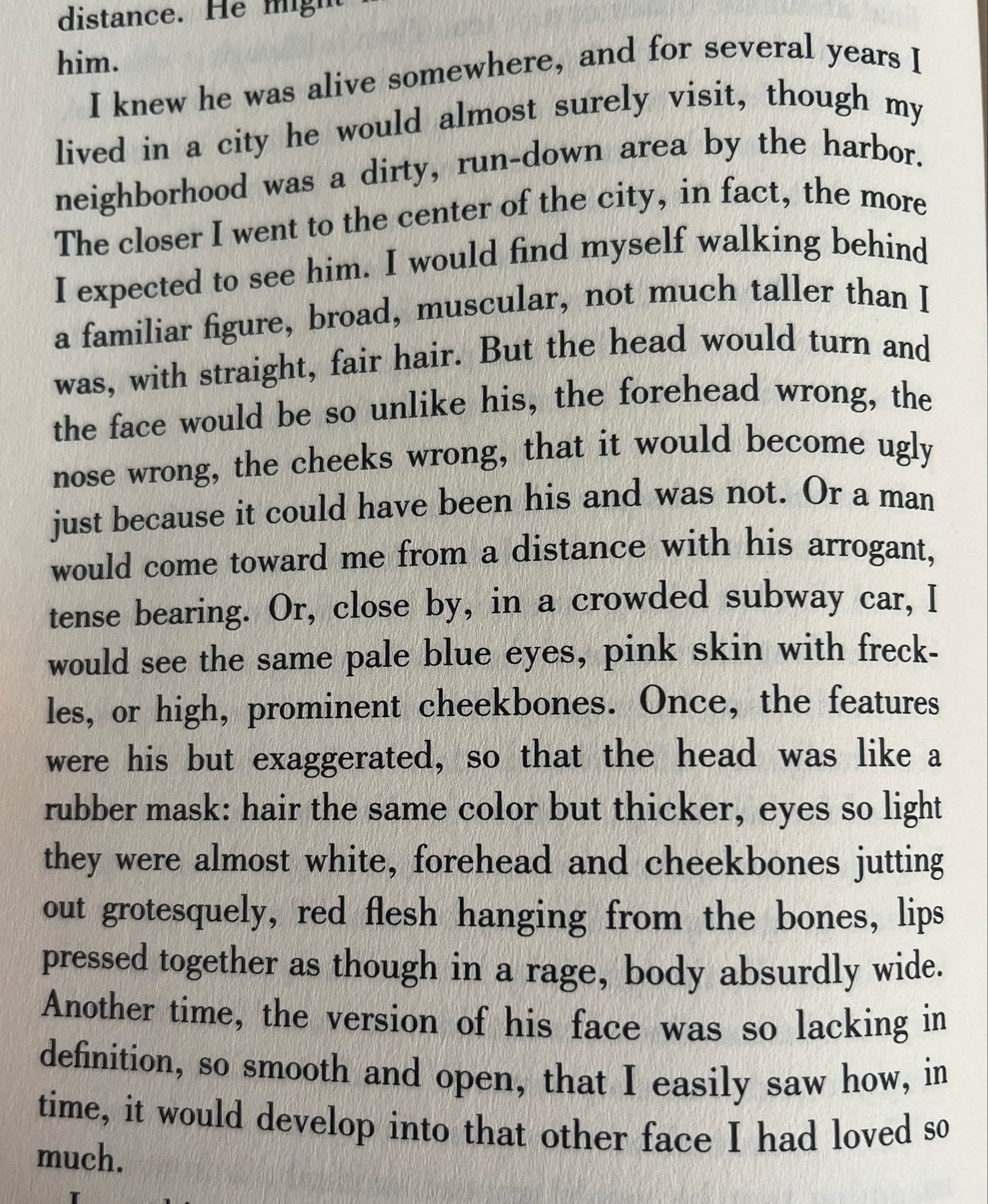
It sounds crazy. But this is the part that’s hard to explain to people who haven’t experienced it: it doesn’t feel crazy while it’s happening. It feels like you’re just living your life, making normal decisions for normal reasons, and if those decisions happen to increase your chances of running into someone you’ve been thinking about, well, that’s just a side effect. A happy coincidence. Not the point, but not not the point.
§
The thing about this kind of magical thinking is that it doesn’t feel like magical thinking while you’re doing it. You’re not consciously performing a ritual, you’re not thinking “if I do X then Y will happen.” You’re simply staying in motion, intending yourself forward, outward, staying alert.
In Austria, I’d walk the same routes my ex-boyfriend had described to me. I’d go to the same bars. Not because I thought I’d find some trace of him there (obviously I wouldn’t, he’d been gone for two years) but because it felt closer. Like I was sharing something with him, even though I wasn’t. Like there was some invisible thread connecting us through these places, even though the only thread was the one I was imagining.
When I try to understand why I did that—why I arranged that period of time based on someone who was barely in my life anymore—I can’t locate a single moment of decision. It was more like: he was taking up room in my head, and that space started pulling me in a certain direction. Not pushing, but pulling, a gentle gravity.
Magical thinking isn’t about believing in magic. It’s about needing to believe that your actions matter, that you have some control over outcomes that are actually just random. That if you follow your impulse, go where you feel called, do the right thing, wear the right clothes, go to the right places, think the right thoughts, the universe will reward you with what you want.
This is what anthropologists talk about when they study rain dances and cargo cults and other “irrational” behaviours. It’s not that people actually believe that dancing will cause rain. It’s that dancing gives you something to do in the face of uncertainty. It converts helpless waiting into action. It lets you feel like you’re participating in your own fate instead of being subject to it.
The crush-run is the rain dance, the cargo cult. We’re building airstrips in the jungle, hoping that if we reproduce the superficial conditions of a natural encounter, maybe the planes will land. Maybe the universe will deliver.
And the universe does reward this behaviour just enough to keep us doing it. Someone really did meet their wife at the party they almost skipped; someone did run into their ex on a street they don’t usually take. The system of cosmic reward works often enough to sustain the superstition.
But I think what David’s story teaches (what my friend Sarah understood immediately) is that encounter geometry only works in hindsight. It’s a retrospective miracle. Only after the fact does the coincidence harden into meaning, the randomness reassembles itself as fate. While you’re in it, it’s just movement—your body treading forth, loading significance into coordinates that are otherwise random.
§
Maybe the outcome doesn’t matter as much as the posture it permits: wanting becomes motility, helplessness inspires direction. It allows you to pretend you’re participating in your own fate instead of just waiting for something to happen. It feels better to be in motion than to be inert, even if that movement is irrational or embarrassing, even if the system has a documented 100% failure rate and says unflattering things about your psychology.
We build our airstrips in the jungle anyway. We do double-takes when walking past cafes, squint into store windows, scan faces at subway stops. Knowing it’s absurd doesn’t cancel the desire.
Sarah will keep running when she has a crush, and I will keep taking the long way home. This isn’t strategy or hope, but the geometry of wanting: the insistence on moving through a reality that refuses to organize itself around our longing, an underlying belief that motion itself might be enough to draw something toward us.
The crush-run defeats itself through its own existence, yet we run anyway. Not because it works, but almost because it doesn’t. Desire, when unfulfilled, demands a detour. Staying still feels like giving up. Some unconscious part of us still believes in the mathematics of coincidence: that if we keep moving, the world might move toward us too.
Love the para where you coin ‘encounter geometry’. Not just spatial either — their interests, when to text (with an almost unconsciously ascertained awareness of their schedule and moods) them, things they’d like all wire themselves into your brain.