

CURATING YOURSELF
A meditation on reference, taste, identity, and expression

The development of our preferences is how we begin constructing a sense of self when we are still grasping at the building blocks of individuality. In those first years of blooming selfhood, we gather our preferences much like precious collectors pinning their specimens—with trembling precision and pride, each choice a delicate thing that shapes our expression of self. The canvas of early consciousness begs to be adorned with whatever catches the light of our attention, what sends those first electric signals of resonance through our being.
In this sense, it is wonderful that our youth offers the most time for aesthetic indulgence. As young children, we lack that precious faculty of discrimination, whether due to some dormancy of judgement or because we are fed such vapid fare in popular culture. One might stop to ask: do we create such entertainments because children cannot yet appreciate finer things, or do their sensibilities stay unrefined precisely because we feed them with such gruel? In those first years, one's cultural diet is rather like that of a domesticated creature, subsisting contentedly on whatever morsels are placed before us by our well-meaning keepers. We graze on the formula of the Disney channel, read the books from the family or school shelves.
But then comes a time where we step into our own autonomy, when curiosity sprouts wings and pushes up against the boundaries of what has been directly fed to us, to insist that we can chart our own course through the infinite landscape of culture. As teenagers, we engross ourselves in the cultivation of our taste, the development of our aesthetic palettes. Like passionate naturalists, we become absorbed in discovering new specimens of meaning, forming attachments to artifacts that feel more substantial than our own nascent sense of self.
The era of teenage curiosity felt exhilarating. I carried within me the wonderment of a child coupled with the dawning discrimination of adulthood—perfect equipment for the great expedition of discovery that lay ahead. I cried at the climax of songs, I devoured books, I put up posters of artists on my bedroom walls. I drew the map of my preferences and began to see it as a reflection of my own mind.
We are taken up in the perpetual task of defining ourselves, through the discerning and defining of our taste. Beginning to parse through the entire expanse of the culture that came before me felt like stumbling onto a monumental pile of artistic artifact. That I was born into this world and had the opportunity to discover it all felt daunting, like I couldn’t possibly begin to make a dent in the expanse of art that had preceded me. In my teenage cultivation of taste, it felt as though I was collecting materials to use in the construction of myself while I was still waiting for life to happen. I had not yet had my first love, so I spent my time picking apart Bjork’s back catalogue.
However, the hunger for new seems to wane with age. A survey from 2018 reported that most (British) people stop listening to new music around age 30. There is a constant conversation concerning how new movies aren’t original, but are simply reboots, remakes, sequels, and prequels. Everything is a reference and nothing feels fresh, but this is on par with how our own hunger for novelty gets suppressed with age. I simply don’t scour the internet in search of anything of interest anymore, where I used to partake in the activity like I was spelunking through culture as a novice voyager, looking for any new horizon that I could catalogue into my narrative of self.
As a teenager, I defined myself through my relentless appetite for my particular interests. I am an appreciator of these books, these bands, this period of cultural history. Now that I’m older, I find that I tend to define myself through my experiences. At what point, then, do we cease to define ourselves through the things we like and compile a sufficient catalogue of reference that we have an established sense of character, one that feels so complete that we aren’t so inherently bound to our interests? At what point do we stop describing ourselves by the things we like, the media we consume, and start to understand the fundamental pillars of our character outside of it?
What am I—what are the defining parts of myself that I have picked up along the way, that I don’t even notice as having been ripped from an external source? I harbor my mother’s wit, my father’s passivity, my sister’s fidelity, my ex-husband’s ambition. But I also contain the affinities towards art that I gathered in my early teens, obsessively combing through Tumblr, where I acquired formative knowledge of Japanese noise rock, Czechoslovak new wave, early minimalist electroacoustic drone, C86 jangle pop. This media imprinted itself upon me as something that was “cool.” I cannot reduce the nature of this attraction, other than, most simply, that I saw someone who I thought was interesting and alien, I saw what they liked and what they felt was important and wanted to be more like them. It is impossible for me to discern whether I first heard I Am Sitting In A Room and was inherently drawn to it, or if I was attracted to being the type of person who appreciates it. For me, the idea of pure self is inseparable from the performance of self.
Does this self-definition through our interests end, or does it merely shift into such a universal expression of identity that we engage it constantly, naturally? Perhaps what we once held up as singular markers of identity become as natural as breathing, no more remarkable than the daily miracle of consciousness itself. The zealous collector becomes the sage who no longer needs to enumerate their treasures. And in time, we discover that curation blooms everywhere—that our peers, too, cultivate their own varieties of passion, their own relationships of artistic revelation. As our palette expands, as we taste more of life's infinite varieties, those first intoxicating encounters with rapture—once so overwhelming in their novelty—become merely notes in a greater symphony of self.
As I get older, I multiply the experiential phenomena that I use to define myself. I have lived in these places, I have studied these subjects at these schools, I have had these friends, and lived these many years, these many days, all containing their own micro-infinity of experience. The individuality of my character has created its own narrative based on that natural passage of life. When we are children, our worlds are much smaller. We go to school, the same school as almost all of the other children we know. We stay enclosed within the social structure of people who are like us, who are of similar economic and cultural background. The kids at school watch the same shows, we read the same books. We yearn to develop a sense of self outside of this corner of life that has been prescribed to us. We can sense that there is more for us to discover.
At a certain point, I started to find it boring and pretentious to perform my interests to others. Largely, people don’t want to hear you wax on about things they’ve never heard about. I learned this during my summer of reading My Struggle when I simply couldn’t stop talking about Karl Ove Knausgaard at every single party I attended, to the point that people started making fun of me for it. When I lived in Austria and fell in love with Prince, I saved the music videos for Kiss and Raspberry Beret on my phone. Sometimes, when a guy was trying to woo me at a bar, I would take out my phone and ask if he had ever seen them. They entranced me so much that I felt compelled to share them as though they were artifacts of myself. But this level of excitement over a particular interest feels increasingly more rare in adulthood. Part of the excitement comes from how rarely I find an artifact that resonates so deeply.
Still, it makes you appear an interesting and knowledgeable person to have encyclopedic knowledge about areas of interest, ready-at-hand whenever the situation calls for it, but obnoxious when the setting doesn't. When I see movies with my friend Seth, we are finally able to indulge each other in the trivia we’ve absorbed through obsessive Wikipedia-combing. My ex-boyfriend used to memorize Shakespeare because he thought that when he was older, this is what adults will discuss at parties. You can imagine his dismay when he grew of age and realized that people are actually just prattling on about this or that, gossiping about things they heard, or recounting recent stories from their lives.
I decided in my early teens that no one and nothing is original, that everything arrives to us via the external. Even ideas feel as though they arrive to me through a mysterious source, as though they are not my own but bestowed unto me through an enigmatic entity. I often think about the Greek word for genius—daimon, the same word for demon— which is something that you have rather than something you are. In the Apology, Socrates describes his daimonion as a divine voice that began appearing to him in childhood. I thought it best to maximize my cultural input, so I may increase my chances at being greeted by this inspired daimon.
I concluded that those who appear original are simply pulling from such a vast range of reference points that, when all put together, present themselves as prototypical. When no one can recognize the source material, they regard something as a novelty. Over-explaining often dullens a thing's unique luminosity; when you find out that the name of the song is taken from a Kerouac book, the bassline is inspired by The Smiths, the intro is ripped from a Youtube clip, the entire phenomenon reveals itself as a patchwork of that which precedes it, when it had initially hit you as a genius stroke of pure originality.
It has always felt like an inherently Libran affect to lean so heavily on my sources of inspiration, that my creativity is at the mercy of what I consume. How fitting that the Libra should be symbolized by scales, the instrument that exists purely to measure the weight of things external to itself. One might say we are collectors of influences, our personalities like intricate mosaics from fragments of all we encounter. But perhaps there is a profound authenticity in this quality—this ability to be so attuned to the external world, to let ourselves be shaped by it with such sensitivity. The Libra is the funhouse mirror of the zodiac.
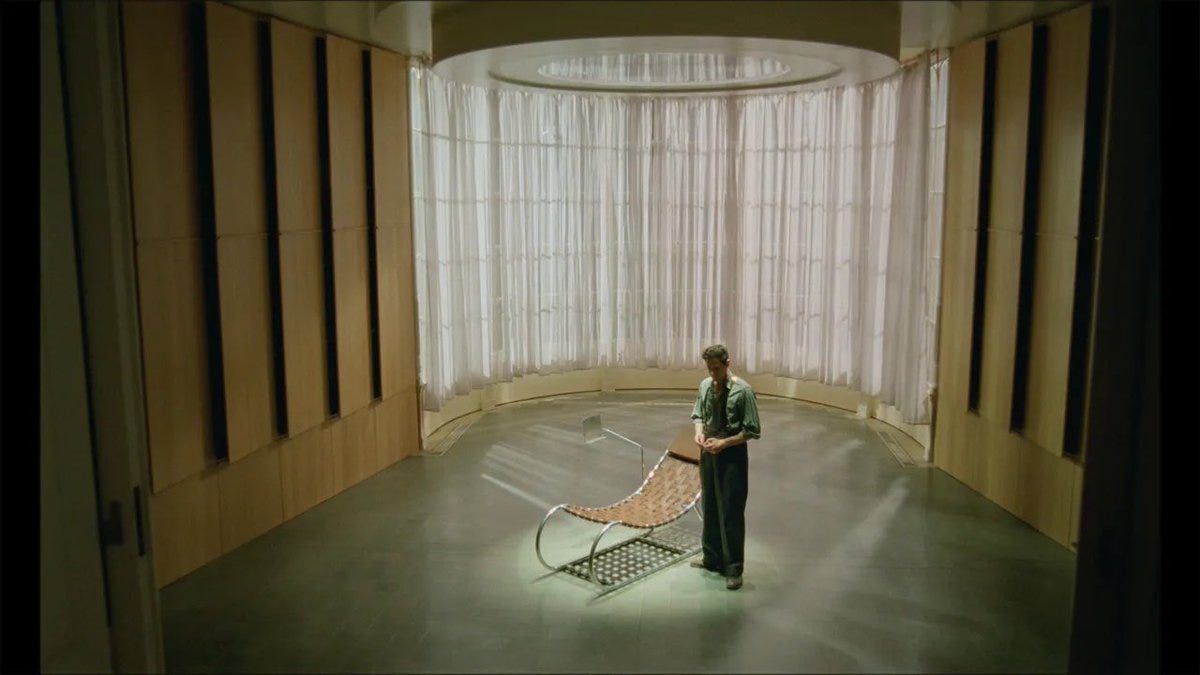
Last night, I saw THE BRUTALIST, and was particularly moved by one moment where László’s wife, Erzsébet, writes to their niece, telling her how László prefers to haunt the hallways of his own construction, to worship himself within his creation, like some architectural Narcissus who finds his reflection not in water but in concrete. The building becomes an externalization of himself, some erection of self-expression. We seek to externalize ourselves to make us more solid. We project ourselves onto what exists outside of us and internalize the external as a means of building up a sense of identity. We all engage, I suppose, in this dance of the outward and inward, as though trying to make ourselves more real through projection and reabsorption. We cast ourselves outward into the material world, then draw back in what we find there, each cycle somehow making us feel more substantial or defined.
There is a seemingly never-ending discourse on the matter of taste over on X.com. These ramblers seem to miss the central text on the subject, Kant’s Critique of the Power of Judgement. For Kant, our experience of the world is inherently structured by our faculties of understanding and judgement. When we engage with objects aesthetically, we don’t passively receive impressions—we're actively constructing our experience through these transcendental processes. The development of taste becomes a way of refining and becoming conscious of our own subjective faculties, a celebration of the dialectical relationship between internal subjectivity and external objects. This is not merely the practice of surrounding ourselves with things we like—it is the creation of an external environment that reflects and shapes our inner life, a symbiotic relationship. When we declare something beautiful or meaningful, we are not merely expressing some pre-existing preference tucked away in our mental filing cabinet. No, we are participating in the endless work of positioning ourselves within the tapestry of existence. Our personal canon becomes a kind of coordinate system by which we navigate the infinite expanse of experience. We are cartographers of our own consciousness, carefully mapping the territory where raw experience meets the realm of subjectivity, each new aesthetic encounter carefully catalogued in the library of our being.
The urge to be seen as “having good taste” is to externalize our sense of self, and have others agree that it is good—a practice of validation. I can’t help but feel delighted and endeared by all the many Tech Guys who have become preoccupied with displaying their peacock-feathers, arguing over matters of taste as if it can be reduced to an objective metric, a methodology with numbered steps. This is simply an exhibition of a natural pattern of subjectivity—to put oneself forth, and hope that others celebrate it. However, they’re engaging in a pattern of bad faith by trying to get in front of each other. They say, if you do not accept my framework of “good taste,” if you see my expressions of self and disagree with them, you are wrong. Or worse, you don’t get it—you, in fact, have bad taste. By denying me, I will deny you.
This dynamic is also where we derive the phenomenon of “gatekeeping.” How curiously protective we become of those most intimate elements of our identity—those precious discoveries that feel less like preferences and more like secrets. We sometimes clutch these treasures close, as though we fear they might be damaged by careless hands or harsh light. That book whose pages seem to contain the very cipher to my soul, or that café whose atmosphere feels attuned to my inner weather that announcing its location feels like a betrayal. The recipe of that sauce which I’ve spent years perfecting; I simply cannot ID my outfit for you because you will take all of my curatorial work and parade it as your own.
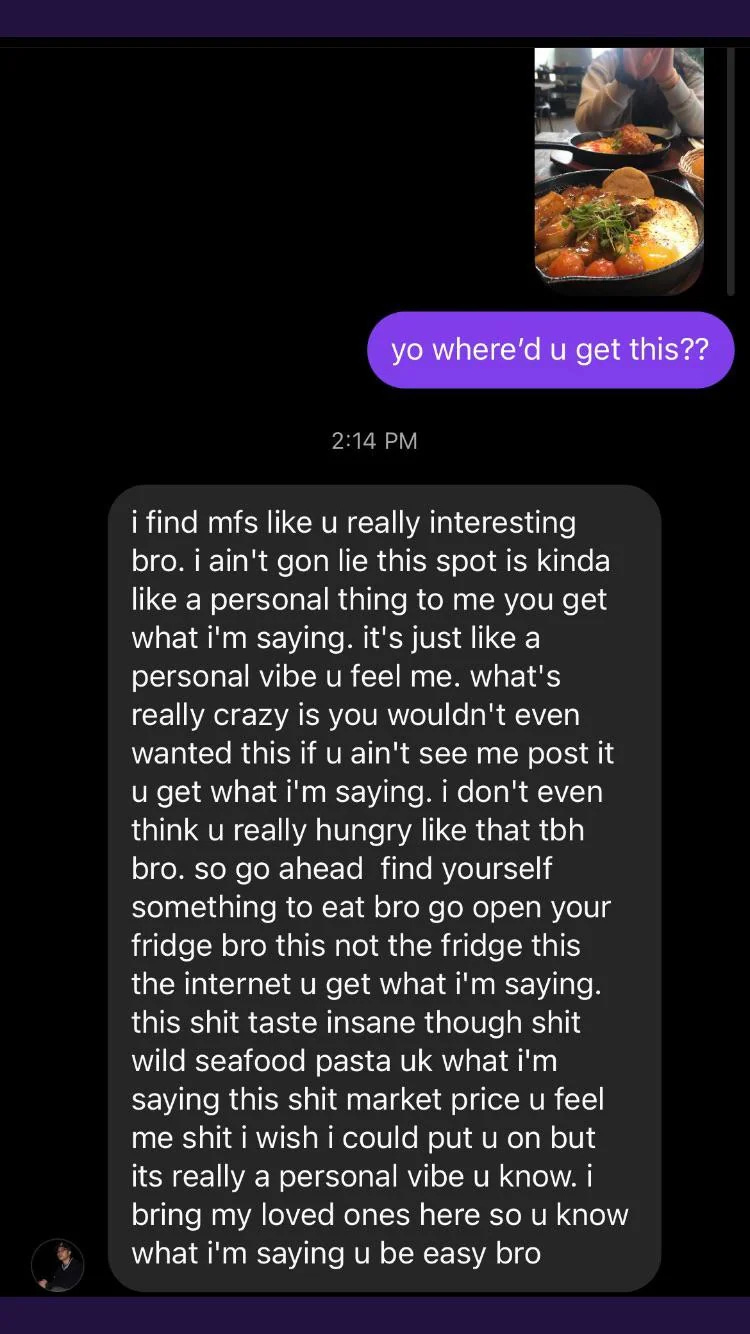
There is something vulnerable about allowing these personal talismans to be known by others. One releases them into the world like fragile paper boats set out on turbulent waters, knowing they may be mishandled, misconstructed, or—perhaps most distressingly—claimed by another who might wear our discovery like a costume, diluting its personal significance. How strange is it that we can feel possessive of things we never truly possessed? But of course, what we seek to protect is not the thing itself, but rather the delicate constellation of meaning we have built around it, the way it has become entangled with our identity. Perhaps this very instinct to guard our aesthetic treasures betrays a deeper truth: that we never truly outgrow our reliance on external markers of identity, we merely become more mature in our relationship to them.
And so, we find ourselves in this curious dance with the world, endlessly collecting and reflecting, building and becoming. Our journey from those early days of frantic consumption to a more settled sense of self mirrors the very process of consciousness itself—a gradual accumulation of experience, preference, and understanding that eventually coheres into something we might call identity. We never truly end this process of external dialogue, but instead relax into it. We become more subtle choreographers of our relationship with the world around us.
Perhaps what changes is not our fundamental nature as collectors and reflectors of our influences, but rather our adeptness in this process. We move from the urgent need to define ourselves through our tastes to a more assured understanding that we are neither purely our influences nor entirely separate from them. We stand, then, at that impossible crossroad where the infinite stream of external influence collides with the finite vessel of individual existence. Through the anxiety-inducing task of becoming oneself—that peculiar process where what is given becomes what is chosen—we transform the configuration of borrowed fragments into something that paradoxically belongs to us alone.
I’ve been doing a lot of thinking about taste as an identity marker and this was really insightful with lots of food for thought! Thank you!