

BEING-TOWARDS-WINTER
More on time, seasons, and Heidegger


I have seen this tweet three years in a row. It never feels like information, only like a warning. From now on the days will narrow, the light will withdraw earlier each night. Not weather, but omen.
I think people are most at home in the season of their birth. One of my philosophy professors once told me his belief that astrology, however irrational, rests on something observable, maybe even empirical: the month you are born leaves its climate in your body. The Leo is marked by the heat of August, carrying its brightness and overwhelm; the Pisces is born in the damp, dissolving edges of February into March, when the ice softens and water starts to leak everywhere; the Libra in October, suspended between summer and winter, the midpoint where light and dark hold each other in tension.
As a Libra myself, I love the season as if it were the climate of my own body. It is when I feel most like myself; my ideas come more easily, it is when the air fits me best.
But fall also makes me anxious—it forces me to see time. While it’s true that time always technically moves the same, in fall you notice it, and this noticing begins to feel oppressive, like when you become conscious of your own breathing and can’t slip back into forgetting. Each day feels faster, though it is not. The evenings close in and you’re confronted with how quickly everything goes. The season insists on reminding you that nothing holds still, and that endings advance more quickly than you care to admit. The warmth retreats, the day collapses into its own shadow, the year is folding shut.
Every night the sun sets earlier, then earlier again, until it feels like time itself is accelerating. The other evening my friend and I went to dinner at 7:30 and, like everyone does this time of year, we remarked on how sudden the change seemed, as if the light had vanished all at once. Of course, it hadn’t. The days have been shortening steadily, predictably, yet it still arrives as a shock. Only weeks earlier we had sat on her balcony, watching the sun set at 8:30, and now we walk to dinner in the dark, wondering how the shift could have crept up so quietly and then declared itself so loud.
Each year, daylight savings feels like a robbery. My thief is punctual: every November, he comes in under the cover of night to steal an hour of daylight. I know this, yet never remember which day he’s due. I never even bother to look it up. Instead I bask in the last scraps of the season until I stumble disoriented out of my bedroom in the morning, to find that the time on my phone no longer matches the clock on the stove. By dinner I am standing in the kitchen, bewildered to find myself cooking in the early dark. And every year it catches me off guard, like some private joke at my expense. It feels malicious, like a foul prank, like the sun itself is mocking me.
When you’re a child and your mother says dinner will be ready in an hour, the hour is endless. At twenty-eight, almost twenty-nine, an hour is nothing. It evaporates before I can even feel it, gone in the time it takes to notice. Because of this, I find myself anticipating its disappearance, watching the clock not to mark what remains but to brace for how quickly it will be gone. In fact, my impulse is to round up, to call it 5 o’clock when it’s only 4:46; to call myself twenty-nine when my birthday isn’t for another month. I have forced myself to stop doing this. As I’ve gotten older I’ve learned to name my age exactly, right up until the moment it’s no longer true. What good is it to be twenty-eight for a whole year if you start being twenty-nine a month too early? This is the same impulse that makes people wish away August for cooler weather. They aren’t just anticipating—they’re throwing time away, skipping ahead, swallowing courses before they’ve even tasted them.
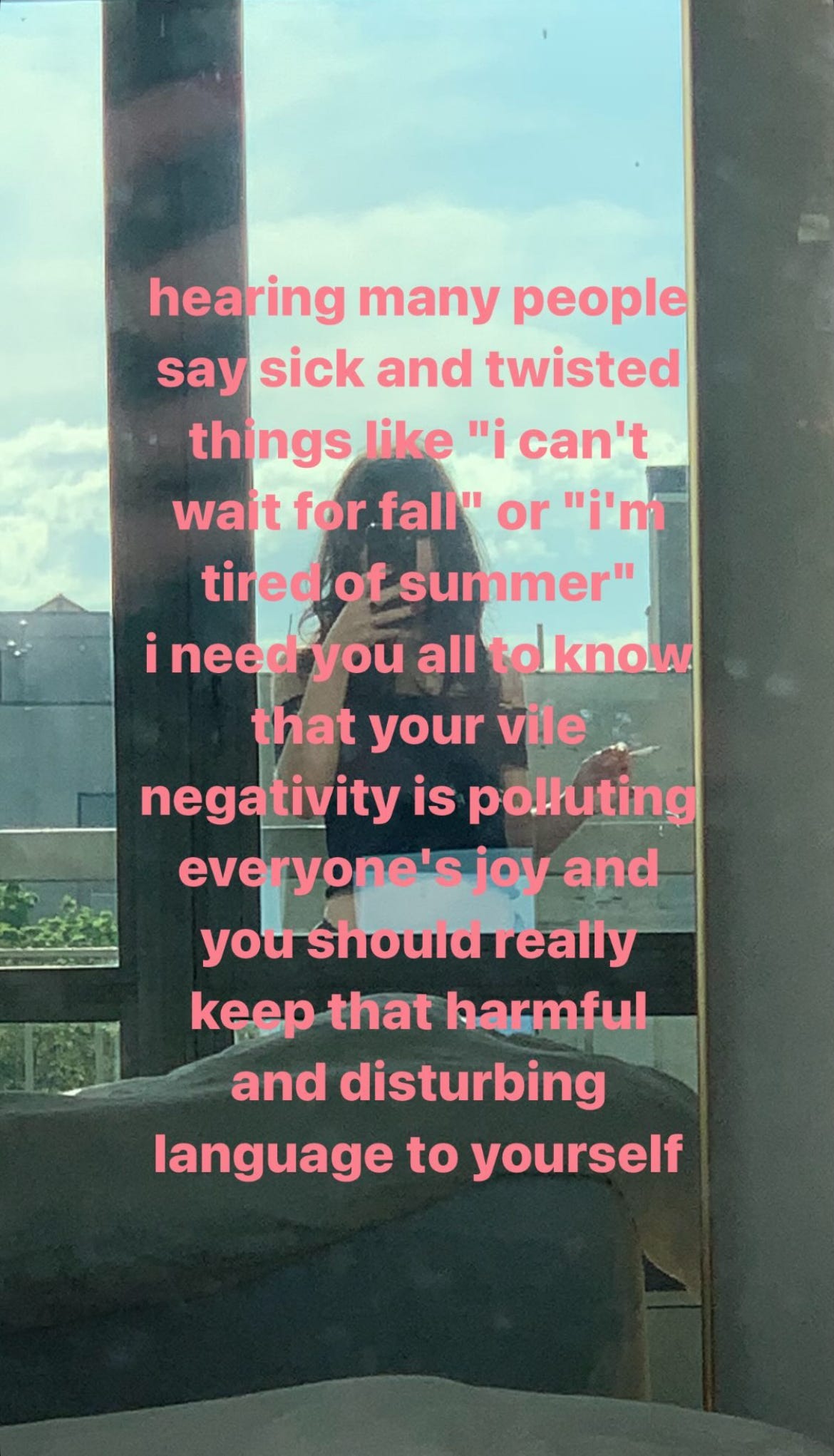
This protest against the pre-empting of time comes from something my mother told me when I was a child, at that age when you first start wanting to act grown up. She said, you are only a child for a very short time, and then you spend the rest of your life being a grown-up. It was one of the few of my mother’s warnings I ever listened to. And when I think of that time (which has now escaped me, as all time is bound to do), I feel a certain relief that I didn’t rush it along. I held it by its right name, if only for a moment, before it vanished. I didn’t try to become older ahead of schedule, to step into an age before it had arrived. I was beginning to understand that it is not your task to get ahead of time. That change is the duty it performs for you, folding into you, carrying you forward, and reshaping you before you ever consent to it.
I haven’t yet learned this with the seasons. The awareness that it is slipping away doesn’t make me live more fully in the moment. It does the opposite. I find myself rehearsing for winter, moving through fall as if it were only a prelude, conserving myself the way a bear fattens before retreating into its den. Noticing time’s movement makes me waste it, as though by acknowledging its speed I lose the ability to inhabit it.
It’s the same feeling I get when I’m at dinner with friends, laughing, drinking, believing myself inside a joyful night, only to notice one of them hunched over their phone, calling a car, plotting their exit. The moment you think you’re in is already being abandoned. The present becomes a passage, not a room.
It is said that time is constant, that, objectively, the hours pass the same for everyone. We all know this isn’t true. Painful hours stretch themselves endlessly, excruciatingly. Sitting in a boring lecture, or trapped in a movie you regret choosing the moment and whose runtime you forgot to check. Good hours, by contrast, vanish. They slip by without notice, like wine poured at the table of a generous host—the glass always, mysteriously full, until the room tilts and you discover you’ve been emptied with it. A lunch with a friend you haven’t seen in years, where you try to compress months into minutes. A good date that ends only because the restaurant closes, and you walk the streets just to keep talking. These are the hours that disappear the fastest, precisely because they are the ones you want to keep.
This season exposes how elastic time really is. The hours don’t actually shrink, yet they seem to tighten, to close in. It’s the same distortion Heidegger described when he wrote about being-toward-death: the sense that the future is not somewhere far off but already pressing into the present, stealing room from it. What distresses me isn’t winter itself but its anticipation—living not in the weather I’m in, but in the one that taunts me. The quiet reminder that the end of the comfortable season is not only inevitable, but already underway. The air is perfect, but inside that perfection I can feel a threat, as though the cold were rehearsing itself beneath the mildness. In summer, I can let a fine day slip by without guilt, certain there will be others. Fall is more fickle: I never know if next week will still be temperate, if the trees will start to look bare, if the air will turn suddenly to a cold sharp enough that I regret wearing a skirt to dinner.
When it is winter, I’m resigned. The cold has already claimed me; there’s nothing left to resist. But fall is different, its chill is still speculative. My instinct is to brace, to guard myself against what’s coming, though there is no defence against the inevitability of time.
Being-towards-Winter is this way of living: not winter itself, but the season bent beneath the weight of its certainty. Each day is lived in anticipation, already shadowed by what follows. The end has not arrived, but its nearness defines the present, pressing into it, hollowing it out. To inhabit fall is to experience the world under the sign of what foreshadows it, to feel the shape of the future casting itself backward. To love fall is to live with this compression, to find preciousness inside the tightening.
This makes me resentful of anyone who wishes anything away. In August, when the heat is unbearable, someone will say they can’t wait for cooler weather. I hear it as sacrilege. How dare you wish away my time. Even suffering has to count. It’s the same impulse that makes people round up the hour or their age. I refuse it by remaining in the time I have, without rounding it up or discarding it early. At least then I know I held the time while it was mine. Pre-empting what’s next feels like tearing pages out of the book you haven’t read, to witness the unsettling speed at which I tumble into my future (and thus, my death) and wish it could happen faster.
And for that reason, I stay at the table even when the night is winding down. I keep walking after dark though the light has gone. Fall makes me feel as if everything is already ending, but it also shows me the only way to be in it, not to rush or plot my exit, but to remain in the passage itself, attentive to every detail, even knowing it leads nowhere but out.
I will see that warning of the early sunset again next year, and the year after. I will feel ambushed by the dark, and still, when it comes, I will step outside and notice the air, the slant of the light. I’ll notice the way time, though moving at the same pace as always, seems to dress differently, revealing itself, even though it had always been there, looping its circle with the same rhythm. I will hate it, and love it, and watch it pass, as if paying better attention to the moment could slow it down.